
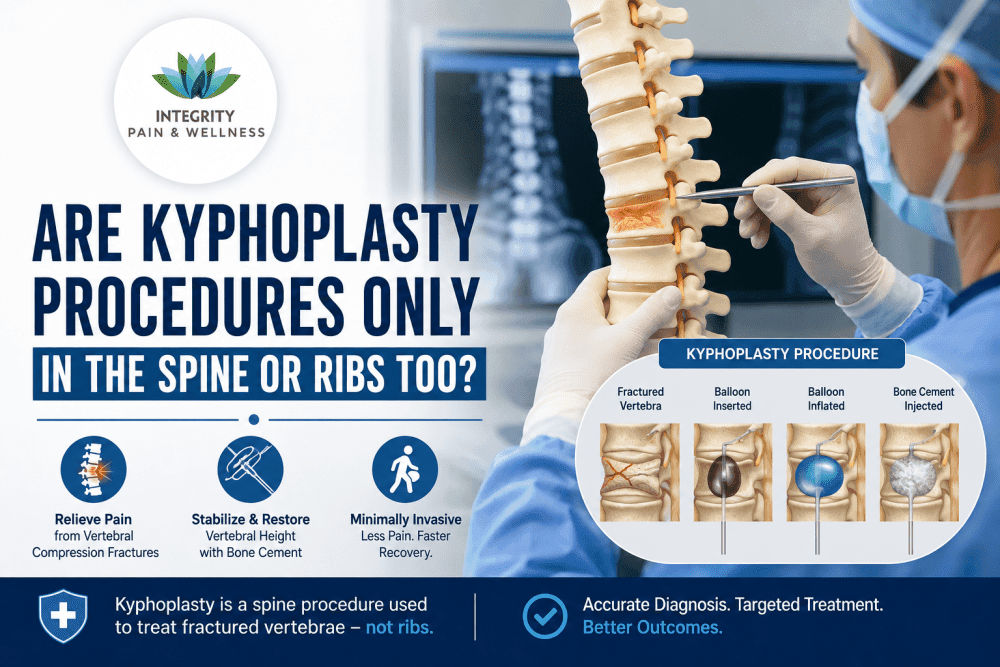
Short answer: Kyphoplasty is a spine procedure, full stop. It's used to treat a broken or collapsed vertebra in the back, and it has no application to a broken rib. If someone tells you they're having "kyphoplasty for their rib," that's a mix-up somewhere along the way, because the procedure simply wasn't built for that bone.
Why People Mix This Up
At Integrity Pain & Wellness, this question comes up more than you'd expect. Ribs and vertebrae both live in the torso. Both can fracture from a fall or from bones that have weakened over time. And both kinds of fractures can leave someone with sharp, breath-catching pain that makes it hard to know exactly where the problem is coming from.

But once you look at the anatomy, the confusion clears up fast. A vertebra is a stout, block-shaped bone that stacks on top of the others to form the spinal column and carries a lot of the body's weight. A rib is long, thin, and curved, and its job is to protect the chest cavity, not to bear weight the way a vertebra does. When a vertebra fractures, it tends to compress or collapse under load. A rib doesn't fail that way, so it doesn't get treated that way either.
Kyphoplasty is built around the shape and job of a vertebra; it has no role in treating a fractured rib.
What Actually Happens During Kyphoplasty
Kyphoplasty is a minimally invasive procedure aimed at stabilizing a vertebra that's fractured or lost height, usually from a compression injury. A physician uses live X-ray guidance to guide a thin instrument through the skin and into the damaged bone. Once it's in place, a small balloon is inflated inside the vertebra. That creates a cavity and, in many cases, lifts the collapsed bone back toward something closer to its original height. The balloon comes out, and the cavity gets filled with a cement-like material that hardens and holds the bone steady from the inside.
This falls under a category of treatment called vertebral augmentation. Vertebroplasty is a close cousin, same idea, but without the balloon step. Neither one has anything to do with the rib cage. Both are designed around the specific structure of a vertebral body.
Vertebra vs. Rib: What's Actually Different
Vertebra (spine) | Rib
Shape | Block-shaped, stacked bone with a canal for the spinal cord | Long, thin, curved bone
Job | Bears body weight and protects the spinal cord | Protects the chest, helps with breathing
Usual cause of fracture | Osteoporosis, compression, trauma | Direct impact, falls, forceful coughing
Can kyphoplasty treat it? | Yes | No
Typical pain management | Vertebral augmentation, injections, medication | Rest, pain control, sometimes nerve blocks
Seeing it laid out this way makes the mix-up understandable but also makes it obvious why the two aren't interchangeable. One bone bears load and can be rebuilt from the inside with cement. The other doesn't work that way at all.
What Actually Leads to a Kyphoplasty Recommendation?
Most patients who end up considering kyphoplasty have a vertebral compression fracture, and there are a few usual culprits:

- Osteoporosis. Bone density drops, and the vertebrae become fragile enough to collapse under everyday stress, sometimes from something as simple as bending over.
- A fall or accident. Trauma can fracture a vertebra outright.
- A tumor or other condition weakening the bone. Less common, but it happens, and it's usually caught on imaging.
Patients showing up with this kind of fracture usually describe back pain that's either sudden, following a fall, or one that's crept up slowly over weeks or months. That's a different story from the sharp, one-sided chest pain that usually signals a rib fracture instead.
When the pain is centered in the back and tied to a collapsing vertebra, kyphoplasty might be worth discussing, chest-wall pain from a rib needs a different conversation entirely.
So How Do You Tell If It's Your Spine or Your Ribs?
This is really the practical heart of the question, so here's how to think through it.
Signs that usually point to the spine:
- Pain sitting along the spine itself, worse when standing or walking
- A history of osteoporosis or a prior compression fracture
- Gradually losing height, or the upper back starting to curve forward
- Pain that worsens with bending or twisting
Signs that usually point to the ribs:
- Sharp pain on one side of the chest
- Pain that spikes with a deep breath, a cough, or a laugh
- A recent hit to the chest or a fall onto your side
- Tenderness when you press directly on one specific rib
Here's the catch: fractures near the thoracic spine, the part of the back where the ribs actually attach, can cause pain that wraps around toward the chest. So a patient might swear the pain is in their ribs when the fracture is really in the vertebra the rib connects to. That's exactly why doctors don't rely on where a patient feels the pain to make the call. They look at imaging instead.
Imaging, X-ray, CT, or MRI, is what actually settles whether a fracture is in the spine, the ribs, or both, not how the pain feels.
What If Someone Fractures Both at Once?
It happens, especially after something like a car accident or a hard fall. A patient can end up with a vertebral fracture and one or more broken ribs at the same time. When that's the case, the two injuries get handled separately. The vertebral fracture might be evaluated for kyphoplasty or vertebroplasty on its own merits, while the rib fracture is managed through its own pain-control plan, typically without any cement or balloon involved. One diagnosis doesn't automatically explain the other, so each fracture gets its own look.
How Integrity Pain & Wellness Approaches Back Pain Like This
Integrity Pain & Wellness is an interventional pain management practice with offices in Scottsdale, Mesa, Glendale, and Prescott, Arizona. The practice's whole approach is built around figuring out where pain is actually coming from before recommending any kind of procedure, rather than treating every backache the same way.

For patients dealing with a vertebral compression fracture, that starts with the practice's back pain services and degenerative disc disease services, both of which lean on diagnostic imaging first. The idea is straightforward: treat the specific bone and the specific cause, not a generic version of "back pain."
The practice describes its mission as compassionate and competent care for anyone dealing with pain, acute or chronic, with a real emphasis on listening to what patients are actually experiencing and shaping treatment around their lifestyle. That's the piece that matters most here, a diagnosis-first mindset is exactly what separates a good kyphoplasty candidate from someone whose pain is coming from somewhere else, like a cracked rib.
Who's Actually Doing These Evaluations?
The clinical team at Integrity Pain & Wellness includes physicians and nurse practitioners with backgrounds in pain medicine, anesthesiology, and family practice, including providers like Amit M. Patel, MD, Bogdan Anghel, MD, and Ahmad Saab, MD, MPH, FAAFP, along with the rest of the team listed on the full provider page. Having that range of backgrounds matters, because sorting out a rib fracture from a vertebral one isn't a guess; it's a diagnostic step that takes the right training and the right imaging to get right.
What To Do If You Think You Might Have a Spinal Compression Fracture
If back pain has shown up suddenly, or it's been building for a while without an obvious cause, here's a practical way to work through it before your appointment:
- Pinpoint where it hurts. Is it centered along your spine, or off to one side near the ribs? That detail matters when you're describing it to a doctor.
- Pay attention to what makes it worse. Pain that flares with breathing or coughing usually points toward the ribs. Pain that flares with standing or walking usually points toward the spine.
- Think about your bone health history. A previous osteoporosis diagnosis, or known risk factors for it, raises the odds this is a vertebral compression fracture.
- Don't guess, get imaged. An X-ray, CT, or MRI is what actually confirms whether it's the spine, the ribs, or both.
- Bring your paperwork. Integrity Pain & Wellness asks new patients to have a referral, previous pain records, discharge letters, and imaging reports on file before scheduling, having those ready ahead of time saves a step.
- Ask your provider directly whether kyphoplasty fits your fracture. Not every compression fracture calls for it, and a rib fracture never does.
What Recovery Looks Like After Kyphoplasty
Because kyphoplasty is done through a small puncture rather than an open incision, recovery tends to be shorter than what you'd expect from traditional spine surgery. Many patients notice pain relief fairly quickly once the cement has hardened and the vertebra is stabilized. That said, recovery still depends on the individual, the extent of the fracture, and any other health conditions involved, so it's not something to generalize into a single timeline.

This is worth mentioning here because it's another point where rib fractures and spinal fractures diverge. A rib fracture usually heals on its own over a matter of weeks, mostly managed with pain control and activity modification, since ribs aren't set or repaired the way a vertebra can be stabilized internally. There's no equivalent "fix it from the inside" option for a rib the way there is for a vertebra. That's one more reason the two injuries end up on completely different treatment paths, even though the road to get either diagnosis usually starts with the same complaint: pain in the torso after a fall or an injury.
Key Takeaways
- Kyphoplasty is a spine-only procedure for fractured or collapsed vertebrae; it's never used for a broken rib.
- Vertebrae and ribs are built differently, break differently, and get treated differently.
- Where you feel the pain isn't reliable on its own. Imaging is what actually confirms the diagnosis.
- A fall or accident can fracture both a vertebra and a rib at once, and each injury needs its own evaluation.
- Integrity Pain & Wellness works through diagnostic imaging and a personalized evaluation before recommending any interventional procedure.
A Few Common Questions
- Can kyphoplasty treat a broken rib?
No. It's designed for the shape and structural role of a vertebra. A rib fracture gets managed differently, usually through pain control and, if needed, a targeted nerve block. - What's the difference between kyphoplasty and vertebroplasty?
Both stabilize a fractured vertebra with a cement-like material. Kyphoplasty adds a balloon step first, aiming to restore some of the height the bone lost. Vertebroplasty skips that step and injects the cement directly. - How can I tell if back pain is a fracture or just a strained muscle?
That's really a job for a physical exam and imaging. As a general pattern, pain that's persistent, worsens with standing or walking, and doesn't settle down with normal rest is more likely to be a fracture than a strain. - Does osteoporosis raise the odds I'll need kyphoplasty someday?
It can. Weaker bone density makes vertebrae more likely to compress or collapse, which is one of the most common reasons kyphoplasty gets discussed in the first place. - Where can I get evaluated for this in Arizona?
Integrity Pain & Wellness sees patients at its Scottsdale, Mesa, Glendale, and Prescott offices. New patients can check the appointment requirements or request a visit directly on the website.
About the Author: Dr. Amit M. Patel, MD, is the contact representative for Integrity Pain & Wellness, an Arizona interventional pain management practice with locations in Scottsdale, Mesa, Glendale, and Prescott. For more on the practice's providers and services, visit the Integrity Pain & Wellness provider directory or find the practice on Facebook.
